
Toward hot-fire: how the AETHER B subsystem test campaign is structured
EMT Aerospace is validating the AETHER B methalox rocket engine subsystem by subsystem, with a clear goal on the horizon: the first integrated hot-fire. Here is how the campaign is structured and why we run it in this order.
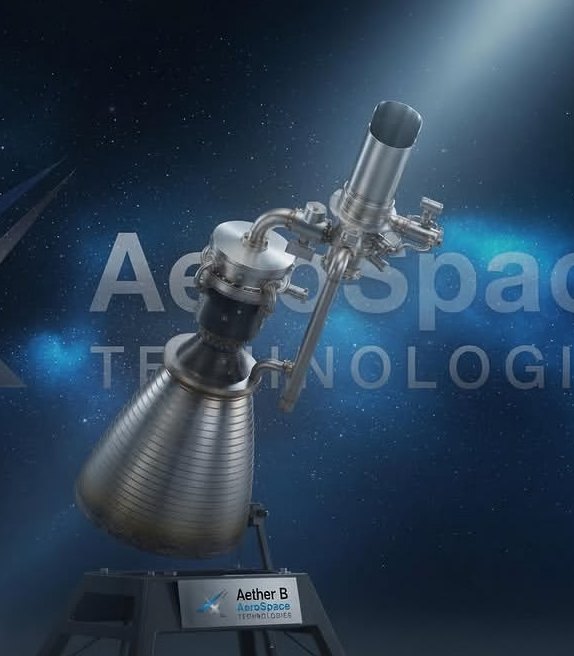 CAD model render
A principle: validate before integrating
AETHER B is the first engine of the AETHER program: a methalox liquid-propellant rocket engine (liquid oxygen and liquid methane, LOX/LCH₄) with a gas-generator cycle, designed to be reusable, restartable and throttleable. Before firing it as a whole, we test every subsystem separately: it is the safest — and, in the long run, the fastest — way to reach a hot-fire without surprises.
This component-first approach is the same one the major space agencies apply to liquid engines: each critical function is isolated, characterized with real geometries and fluids, the data is correlated with the models, and only when every piece behaves as expected do we move to integration. Every result is traceable and repeatable.
The subsystems under test
In sequence, one at a timeThe campaign covers, in sequence, the subsystems that determine the engine's performance, reliability and safety.
Injection and mixing
Cold-flow tests of the injector to measure pressure drop, distribution and spray quality of LOX and methane: this is where stable, efficient combustion is born.
Ignition chain
Verification of the ignition system for a reliable, repeatable start of the methane-oxygen mixture: an essential requirement for an engine that must restart in flight.
Fluids and cryogenics
Cryogenic conditioning, line chill-down, tank pressurization and feed sequences: handling LOX and liquid methane at the right temperatures is half the job.
Valves and actuators
Sealing tests, response times and cryogenic-temperature cycling of the main valves, which time the start-up, throttling and safe shutdown.
Gas generator
Dedicated tests of the gas generator, the combustor that drives the turbopump in the chosen cycle: its temperatures and flow rates are characterized before integration.
Chamber and cooling
Flow tests in the regenerative cooling channels and structural pressure checks of the thrust chamber, which must withstand extremely high heat fluxes while remaining intact and reusable.
The cold-flow tests
Before any combustion, the engine is tested 'cold': inert fluids or the propellants are run through it without ignition, to validate the fluid dynamics, the valve-opening sequence and the behavior of the feed system. Cold-flow tests remove much of the risk before fire is introduced.
From ignition to the gas generator
The next step lights the first functions: the ignition chain and the gas generator are tested as a unit, characterizing the start-up and operation of the subsystem that spins up the turbopump. It is the bridge between component tests and firing the complete engine.
The goal: the integrated hot-fire
The campaign converges on the first integrated hot-fire: firing the complete engine, anchored to the test stand. This is the moment when the subsystems work together and the quantities that matter are measured — thrust (~758 kN design class at system level), chamber pressure, specific impulse, thermal behavior and, above all, combustion stability.
The first hot-fires are short; the duration is then progressively extended and the capabilities that make AETHER B a modern engine are explored: throttling and restart, indispensable for propulsive return and reuse of the launcher.
Test stand, instrumentation and safety
A hot-fire is worth as much as the data it produces. The test stand we are defining will have to integrate load cells for thrust, high-frequency pressure and temperature sensors, high-speed video, the propellant storage and feed plant and the safety systems — water cooling, protections and remote control from a bunker. Data acquisition is the true product of every test.
The qualification milestones
The entire campaign is punctuated by formal review gates (MCR → SRR → PDR → CDR → SIR → FRR) and by progressive reference missions, from the first low-Earth-orbit flight to lunar missions. Detailed vehicle design advances only upon verifiable passing of the propulsion validation milestones: no shortcuts on safety.
Concept images for illustrative purposes. Values are given at system level; detailed design parameters, geometries, materials and architectures of AETHER B are the reserved intellectual property of EMT Aerospace Technologies S.r.l., shared exclusively under a non-disclosure agreement (NDA).
Frequently asked questions
The most searched answersWhat is a hot-fire test?
It is the ground firing of the complete engine, anchored to the test stand, to measure its thrust, pressures, temperatures and stability under real but controlled conditions. It is the test that validates the entire engine before flight.
Why does AETHER B use methalox (methane and oxygen)?
Methalox (LOX/LCH₄) offers a good balance of performance and cost, combustion that leaves fewer carbon deposits in the chamber — a condition favorable to reuse — and easier handling than other propellants. It is also compatible with future in-situ propellant production.
How far along is the development of the AETHER B engine?
EMT has begun the subsystem test campaign, which will culminate in the first integrated hot-fire. Development is gradual and verifiable; the published values are design values, at system level.
How much thrust will the AETHER B engine have?
The design thrust class is about 758 kN at system level. AETHER B is the common engine of the Orbital Lume launch vehicle, used both in the first stage and, in an extended-nozzle variant, in the upper stage.
Follow the AETHER program
We will publish the campaign's progress as the subsystems pass their tests. For industrial partnerships, supply and research, let's talk.