
EMT-NEP-X: calculation-based verification of the 1 MW microreactor completed
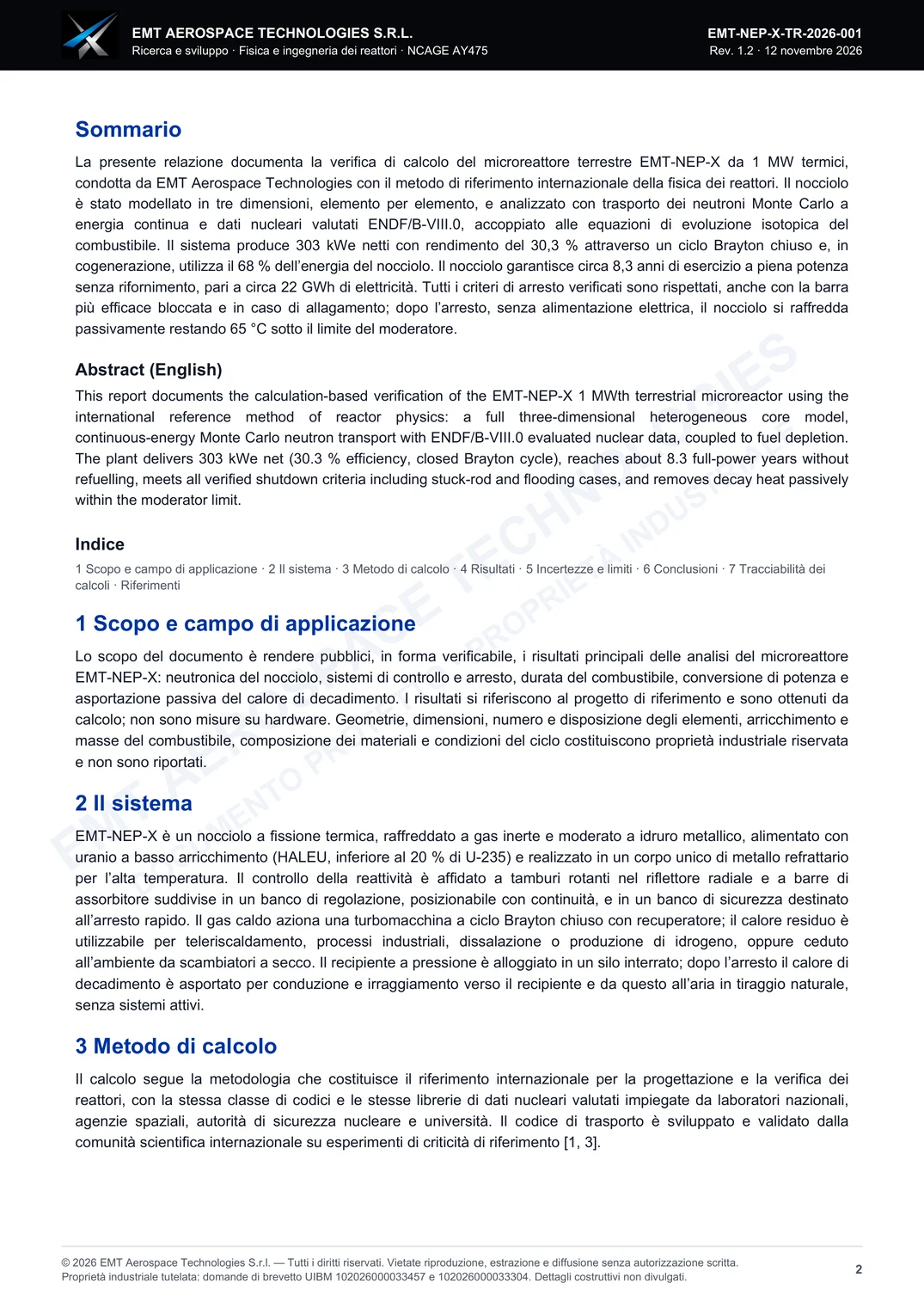
EMT Aerospace Technologies has completed the calculation-based verification of the EMT-NEP-X terrestrial microreactor: full-core neutronics, fuel life, control and shutdown systems, power conversion and passive safety. The calculations, run on the EMT Compute platform with the international reference method of reactor physics, confirm a 303 kWe system that operates for about eight years at full power without refuelling.
A complete system, verified by calculation
The EMT-NEP-X microreactor shares its core with EMT’s nuclear electric propulsion program: a single refractory-metal body, gas-cooled and moderated by a metal hydride, fueled with low-enriched uranium. In the terrestrial version the core heat drives a closed Brayton cycle and produces electricity and useful heat for remote sites, industry, district heating, desalination and hydrogen.
The calculation campaign followed a complete engineering development plan, from the core to the containerised plant: every check that showed an insufficient margin was corrected and recalculated before moving to the next phase. It is the same discipline used to qualify reactors: measure, correct, document. Update of 12 November 2026: the calculations were repeated on the final core configuration, with the actual working gas of the cycle, shutdown at room temperature and the final moderator composition. Full-power life is about 8.3 years, also verified for the fuel element, and all shutdown criteria are still met, including with the most effective rod stuck and in the event of flooding; the plant shielding analysis has also been completed.
Method: the international standard of reactor physics
We adopted the same methodology, the same class of calculation codes and the same evaluated nuclear data libraries that form the international reference for reactor design and verification, used by national laboratories, space agencies, nuclear safety authorities and universities. The code is developed and validated by the international scientific community against benchmark criticality experiments. Every result is reproducible: model, data and calculation settings are documented.
Complete three-dimensional model
The core is described element by element in three dimensions: every fuel rod, the moderator, the reflectors, the control drums, the rods and the gas channels, without simplification or homogenisation.
Continuous-energy Monte Carlo transport
Each neutron is followed individually from birth in fission to absorption or leakage, with interaction probabilities in continuous energy: this is the reference method, free of the approximations of deterministic methods.
Reference evaluated nuclear data
Neutron interaction probabilities come from the international evaluated nuclear data library ENDF/B-VIII.0, including temperature effects and the chemical binding of hydrogen in the moderator.
Declared uncertainties
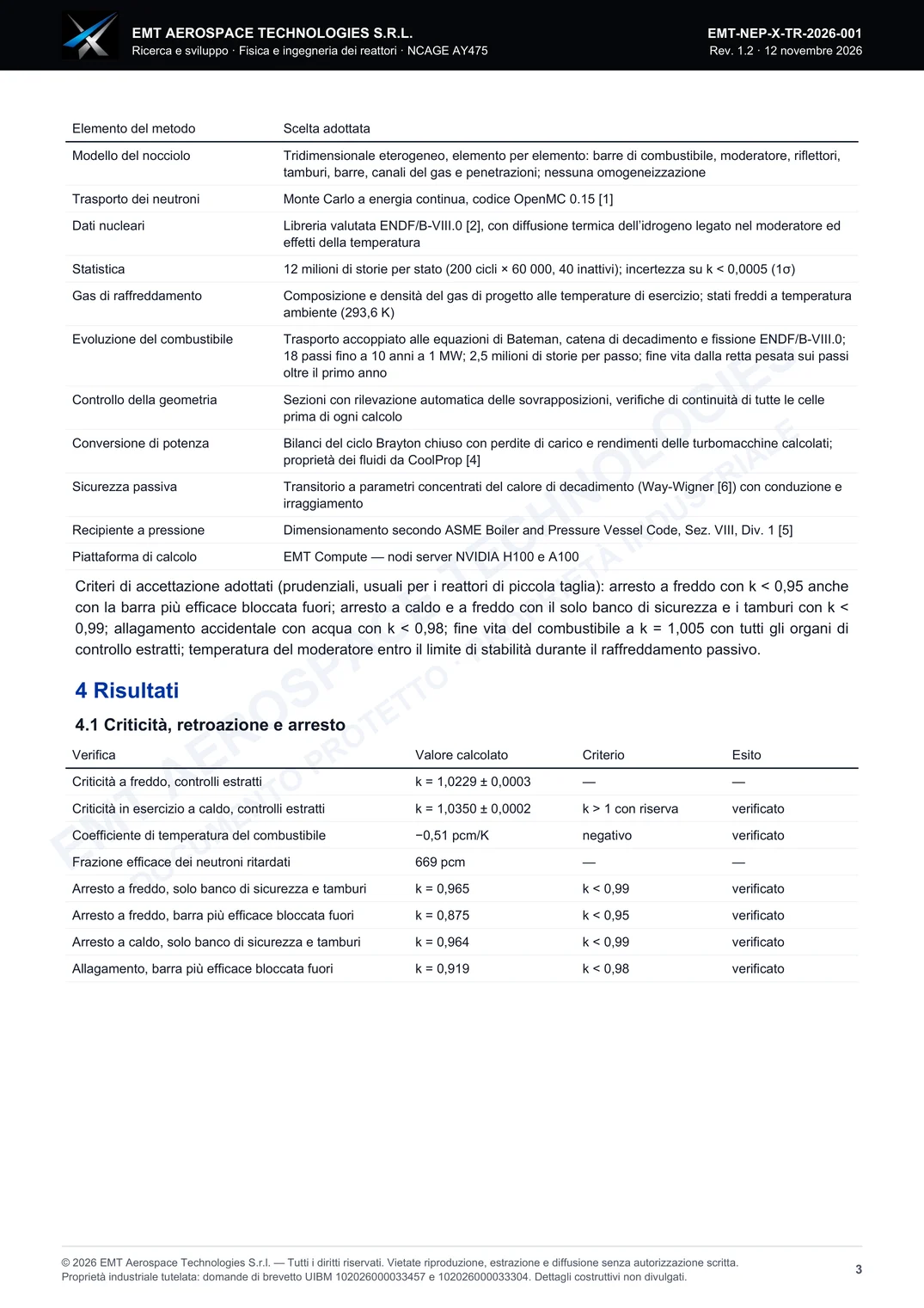
Every value comes with its statistical uncertainty: 12 million neutron histories per state, uncertainty on k below 0.0005; the curves show the 2σ band.
Fuel evolution
Transport is coupled to the isotopic evolution equations, with the ENDF/B-VIII.0 decay and fission chain, to calculate how the core changes over years of operation at 1 MW.
Conservative acceptance criteria
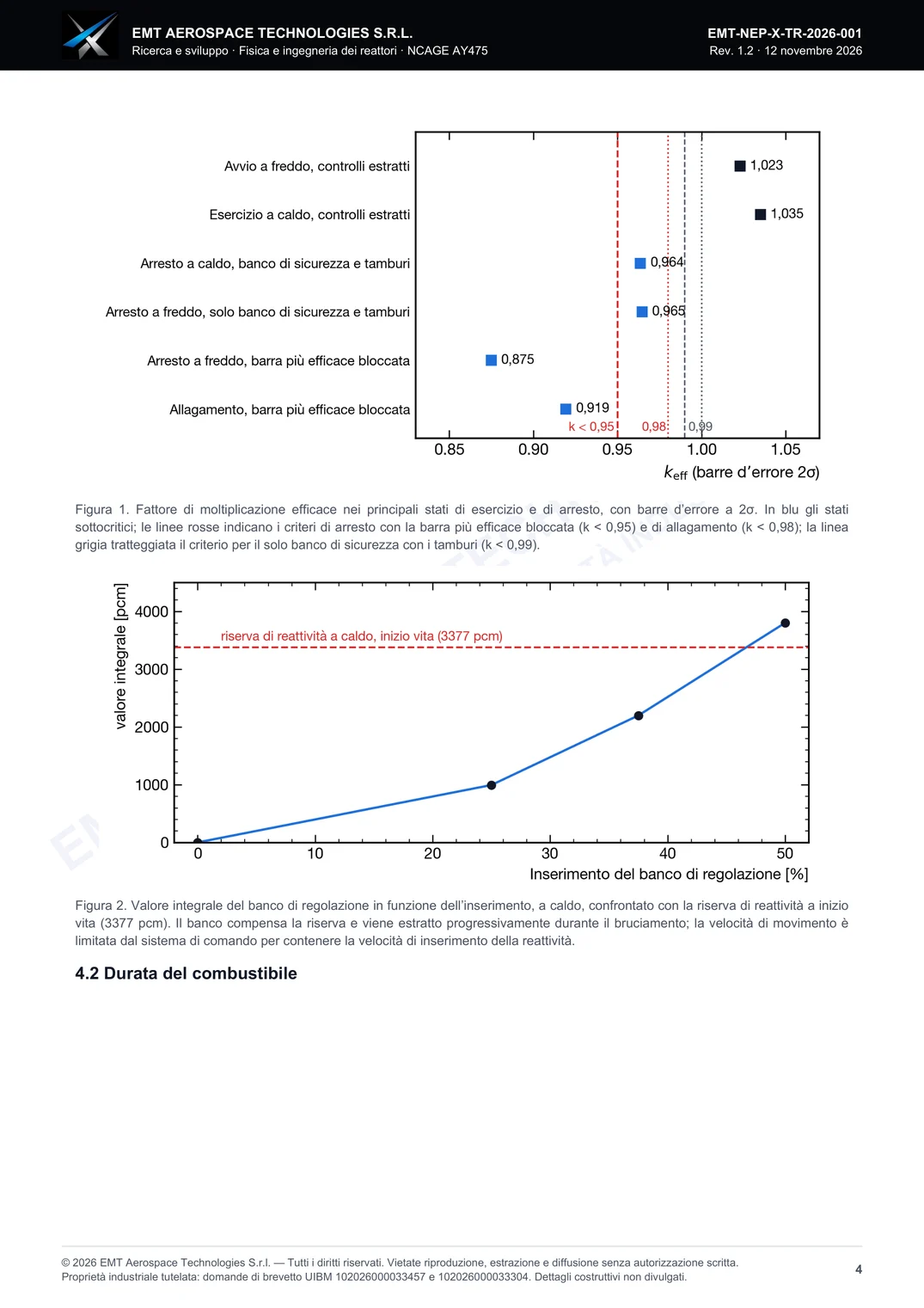
Results are compared against conservative criteria customary for small reactors: cold shutdown with k < 0.95 even with the most effective rod stuck, shutdown with the safety bank and drums alone with k < 0.99, flooding with k < 0.98, end of life at k = 1.005, moderator within its stability limit.
The results
Burnup at full power
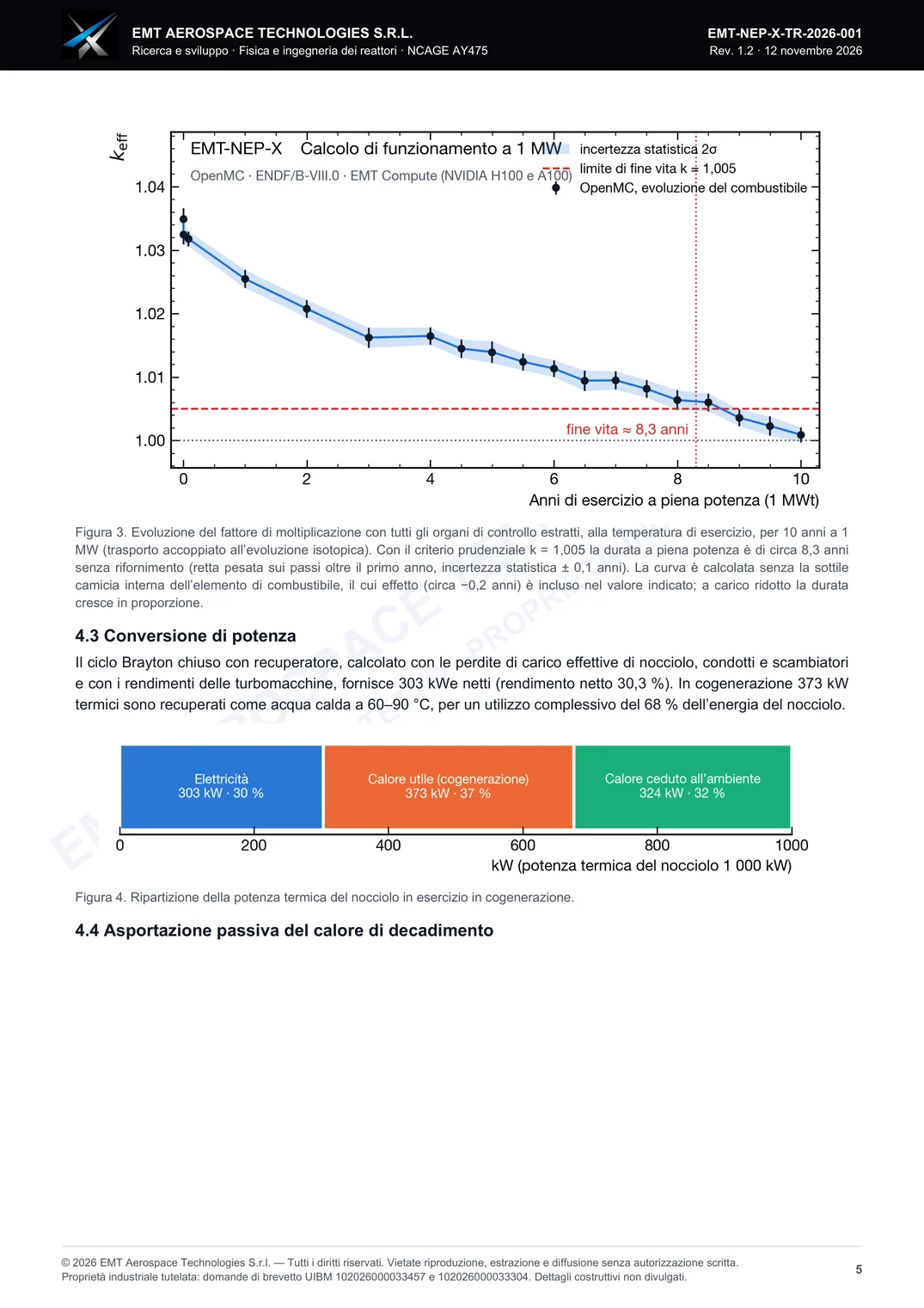
Multiplication factor k with all control elements withdrawn, at operating temperature, for up to 10 years at 1 MW: Monte Carlo transport coupled to the isotopic evolution equations (ENDF/B-VIII.0 decay and fission chain). The band shows the 2σ statistical uncertainty. With the conservative end-of-life criterion k = 1.005 the core delivers full power for about 8.3 years without refuelling, about 22 GWh of electricity; at reduced load the life increases proportionally. The curve is calculated without the thin inner liner of the fuel element, whose effect (about −0.2 years) is included in the stated value.
Operating and shutdown states
k calculated in six core states, each with 12 million neutron histories. In operation the reactor has a reactivity margin that compensates burnup; when cold, with all rods and drums inserted and the most effective rod stuck out, k = 0.875 (criterion k < 0.95); the safety bank with the drums alone is enough to make it subcritical (k = 0.965); even if flooded with water, a reference accident for transportable reactors, and with the most effective rod stuck out, the core stays below the k < 0.98 criterion.
Summary of verifications
| Check | Calculated value | Criterion | Outcome |
|---|---|---|---|
| Criticality in hot operation | k = 1.0350 ± 0.0002 | k > 1 with burnup reserve | ✔ verified |
| Fuel temperature coefficient | −0.51 pcm/K | negative | ✔ verified |
| Cold shutdown, safety bank and drums | k = 0.965 | k < 0.99 (single system) | ✔ verified |
| Cold shutdown, most effective rod stuck out | k = 0.875 | k < 0.95 | ✔ verified |
| Hot shutdown with safety bank and drums only | k = 0.964 | k < 0.99 | ✔ verified |
| Flooding, most effective rod stuck out | k = 0.919 | k < 0.98 | ✔ verified |
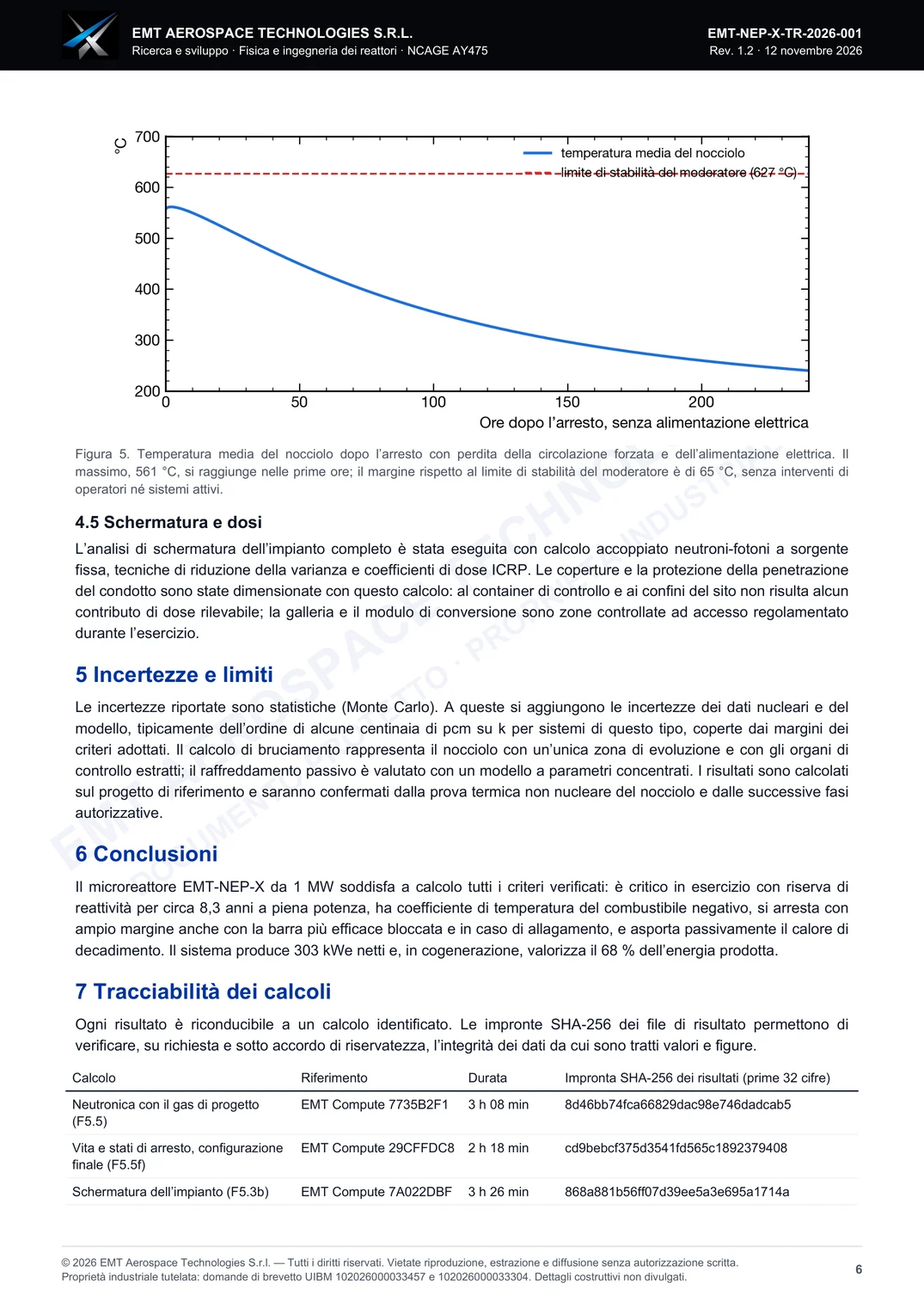
| Passive cooling without electrical power | 561 °C max | < 627 °C | ✔ verified |
| Full-power life without refuelling | ≈ 8.3 years | k ≥ 1.005 | ✔ verified |
The technical report
EMT-NEP-X-TR-2026-001The results are collected in technical report EMT-NEP-X-TR-2026-001, which can be read here page by page. The original document is protected and is shared with research bodies, industrial partners and institutions under a non-disclosure agreement.
Document in Italian · © 2026 EMT Aerospace Technologies S.r.l. · reproduction prohibited
Next steps
Next come the complete construction design, manufacturing qualification of the monolithic body with dedicated test pieces, the non-nuclear induction thermal test of the core, the subject of an EMT patent application, collaborations with research bodies and universities, and the licensing path for the nuclear phases.
Work with the EMT-NEP-X program
Research bodies, universities, agencies and industrial partners can request detailed data under a non-disclosure agreement.