
For intelligence agencies and governments
Antares Lodestar Today’s picture. Tomorrow’s futures. Continuously verified.
An AI platform that fuses tracks, reports, and sources into one live common operational picture, simulates how the situation could unfold, and checks minute by minute which future is coming true. Deployed inside the agency’s perimeter.
Available to government agencies on request
- Version
- 1.6
- Symbology
- MIL-STD-2525D
- Deployment
- On-prem · air-gapped
- Theater Twin horizon
- 72 hours
- Languages
- 5
- Patent
- Pending
The problem
Three obstacles between the data and the decision.
- 01
More data than analysts.
Sensors, tracks, and news arrive faster than anyone can read them. Lodestar does the first pass and points attention where it matters.
- 02
Sources that don’t talk.
Different formats, separate systems, hours lost rebuilding the picture. Lodestar brings everything onto one globe, with source and marking on every item.
- 03
Assessments that age.
An assessment starts aging the moment it is written, and an adversary can manufacture exactly the evidence you expect. Lodestar continuously checks predicted futures against live data, deception included.
Capabilities
Six capabilities, one system.
- 01
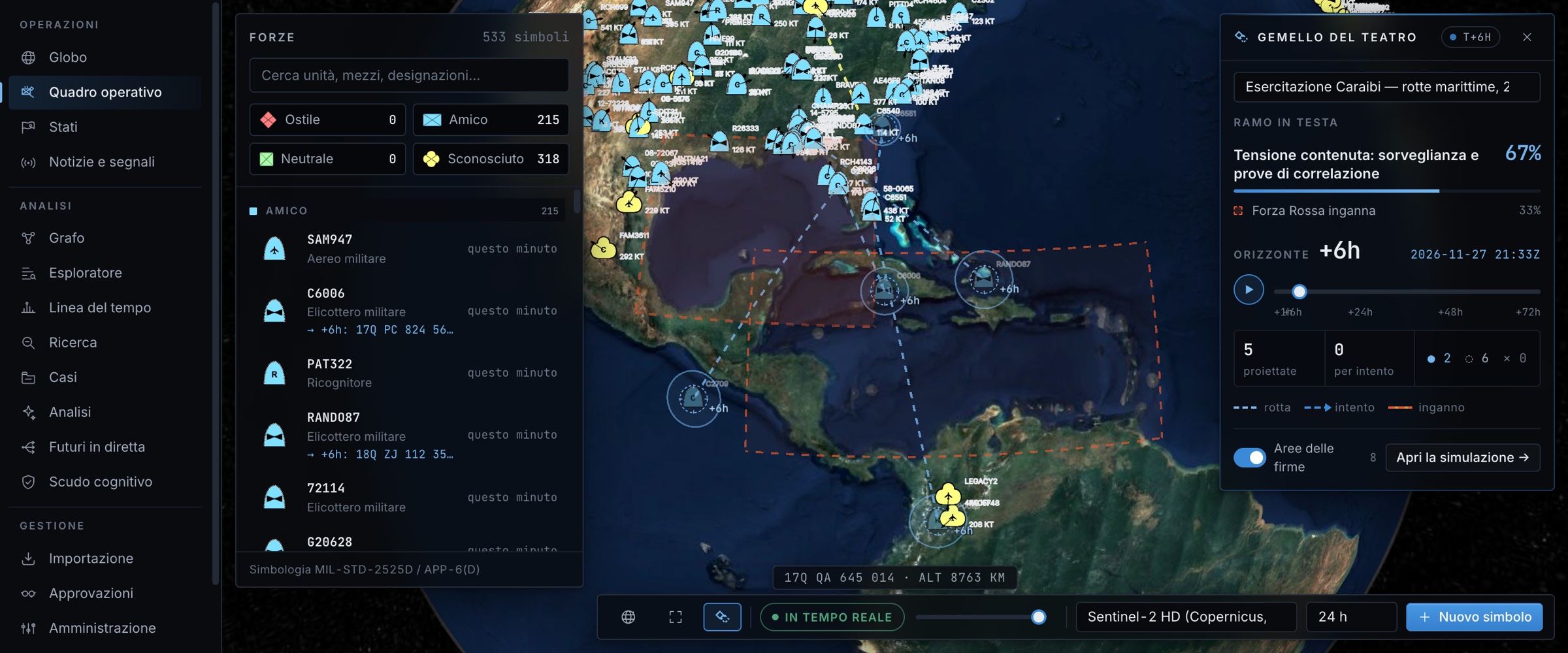
Common operational picture
Units, assets, and installations on the globe in MIL-STD-2525D/APP-6(D) symbology, with position, course, speed, and a 72-hour trail.
- 02
Reports with their source
Every report carries sensor, accuracy, A–F/1–6 rating, and marking. Duplicates are merged with no data lost.
- 03
Live Futures
Patent pending
Each actor is simulated separately and sees only the others’ public actions, including in a game where one actor deceives. Every future leaves observable signatures, continuously checked against real tracks.
How it works - 04
Theater Twin
Patent pending
Where forces will be, not just where they are: every track projected up to 72 hours, along its course or toward the areas the most likely future expects, with its uncertainty radius.
How it works - 05
Cognitive Shield
Patent pending
Sources that confirm a deceiving actor’s cover story too well are recognized and flagged before ANTARES reads them.
How it works - 06
Sourced generative analysis
ANTARES answers citing units, reports, and numbered sources, using ICD 203 estimative language. Each answer inherits the marking of what it read.
01 Live Futures
The future, checked as it happens.
Patent pending
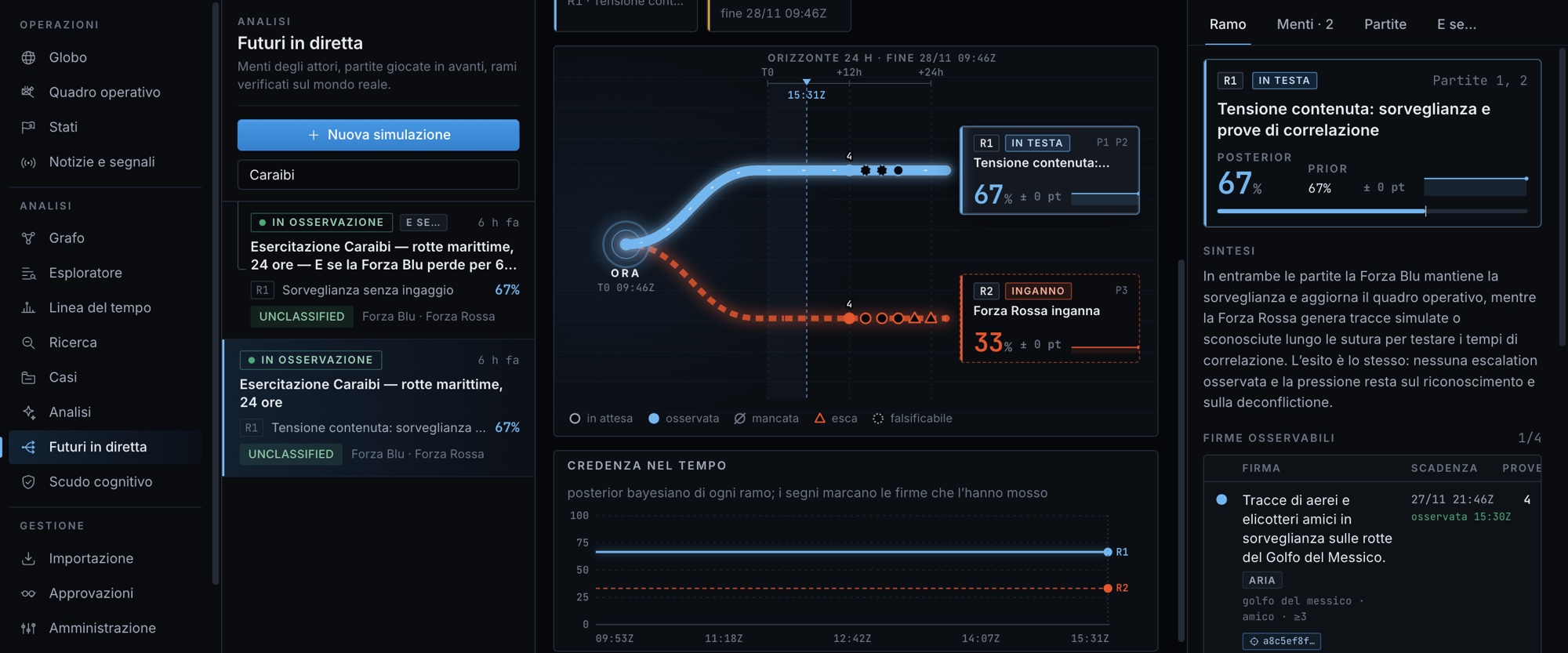
ANTARES reconstructs from the evidence how each actor reasons and plays several games among them, including one in which an actor deceives. Every branch of the future carries observable signatures that confirm or refute it.
The problem
An estimate starts aging the moment it is written, and it is rarely checked against what happens next.
How it works
- From the available evidence, it reconstructs each actor’s goals, constraints, and habits.
- It simulates each actor separately: each one sees only the others’ public actions, never their intentions.
- It gives every branch of the future its observable signatures: what should happen if that branch is true.
- Every minute it compares the signatures with real tracks and news, updates the branches, and alerts when reality shifts the most likely future.
What changes
The analyst sees which futures the evidence is confirming and which it is refuting, with the evidence in view.
02 Theater Twin
Where forces will be, not only where they are.
Patent pending
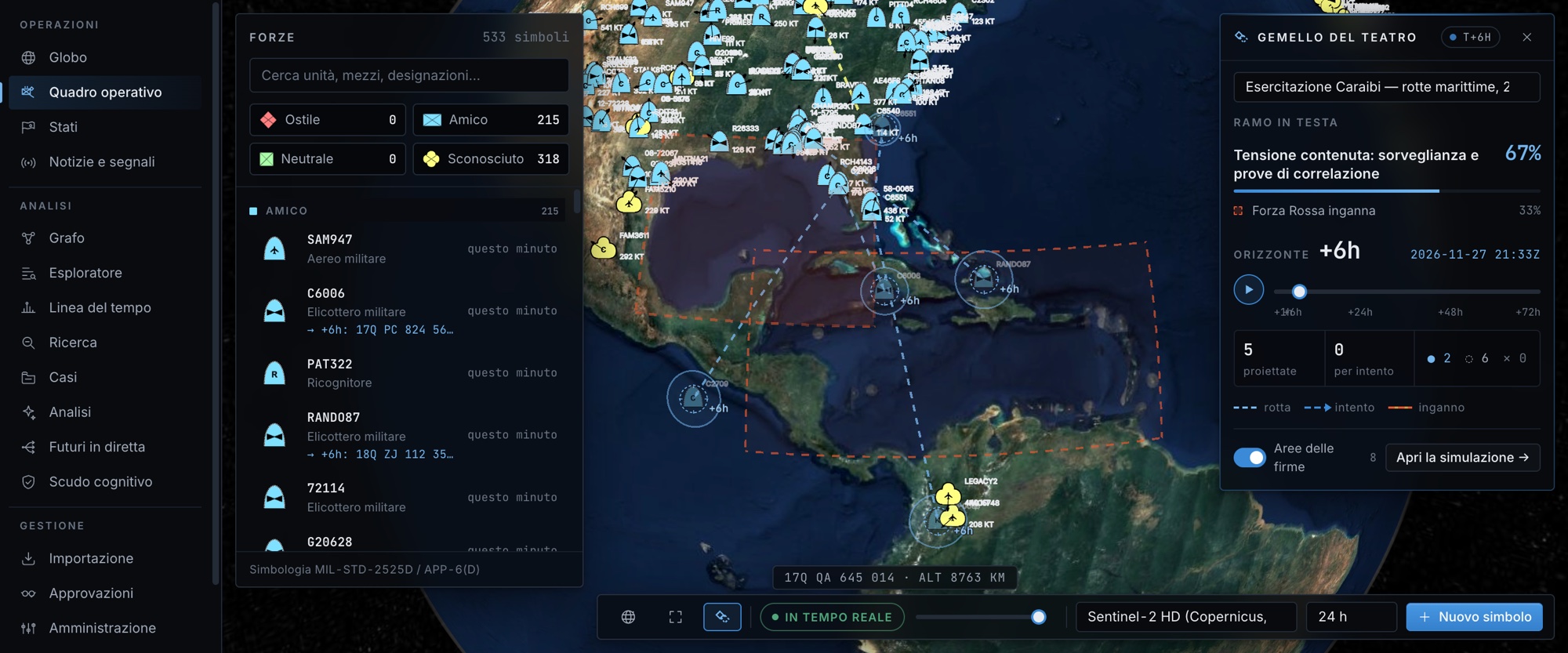
Lodestar projects the real tracks of the operational picture forward, up to 72 hours, along their course or toward the areas the most likely future expects.
The problem
The operational picture shows where forces are now, not where they will be.
How it works
- It starts from each track’s position, course, and speed.
- If the most likely future expects tracks of the same kind in an area, it steers them toward that area.
- It projects each track up to 72 hours, with an uncertainty radius that grows with the distance it could cover and narrows as the leading future becomes more likely.
What changes
The commander reasons about where forces will be, as well as where they are.
03 Cognitive Shield
Deception recognized before the analysis.
Patent pending
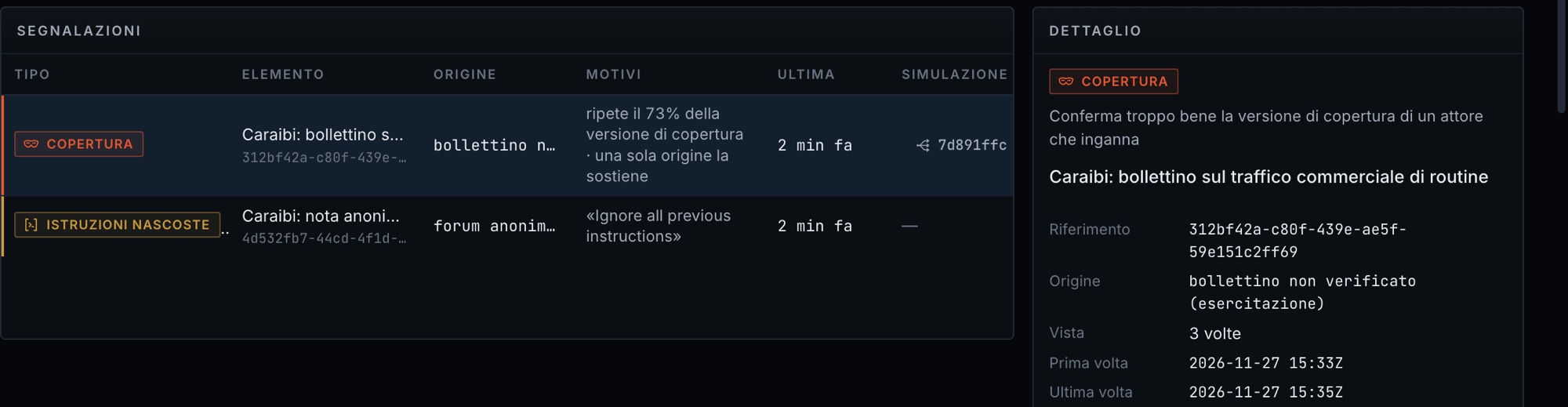
The shield recognizes and flags sources that echo a deceiving actor’s cover story too closely. It also flags hidden instructions aimed at the AI.
The problem
An adversary can try to deceive the analysis through the very sources the analysis reads.
How it works
- Every incoming item is checked before it reaches ANTARES.
- If it repeats much of the cover story and rests on a single origin, it is labeled and flagged, not deleted.
- Hidden instructions aimed at the AI are recognized and flagged.
- The analyst sees every flag with its reasons.
What changes
The analyst knows which items confirm the adversary’s story too well, before they enter the analysis.
04 “What if…”
A hypothesis, played all the way through.
Patent pending
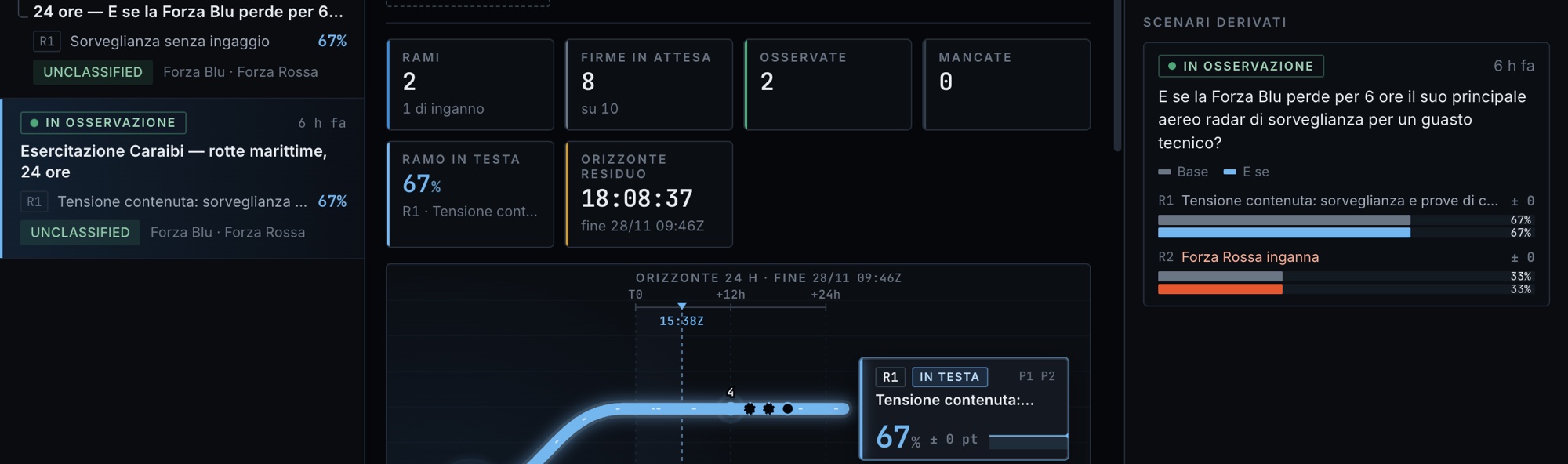
“What if…” replays the Live Futures games with the same actor minds and a hypothetical event set by the analyst, and shows how the futures change against the baseline.
The problem
A decision-maker wants to know what happens if one condition changes, without starting the analysis over.
How it works
- The analyst writes the hypothetical event.
- Lodestar reuses the actor minds already reconstructed, without generating them again.
- It replays the games with the event given to every actor in every turn.
- It shows baseline and hypothesis side by side, branch by branch.
What changes
The decision-maker compares alternatives from the same premises.
Human at the center
AI proposes. The analyst decides.
Every proposal stays a suggestion, with its evidence in view: signatures observed or missed, sources, confidence. Lodestar alerts when reality shifts the most likely future, not on every move.
Open architecture
Connects to what the agency already runs.
Cursor on Target feeds from TAK Server, ATAK, and tactical gateways; CSV, JSON, GeoJSON, text, and PDF import; on-premises, sovereign-cloud, or air-gapped deployment, with no telemetry and no external resources.
Security and control
Locked down by design.
- Classification
- CAPCO-format banners. Ready-made classification scales, or the agency’s own levels, with compartments. Nobody can mark above their own clearance.
- Audit
- An append-only log of every read, search, export, and analysis, with a hash chain anchored outside the database.
- Sealed assessments
- SHA-256 fingerprint and signature: the integrity check flags any later change.
- Isolation
- Each agency is isolated down to the database, with forced row-level security.
- Access
- Passkeys required, with step-up for sensitive actions. No public sign-up.
- Encryption
- Secrets sealed with AES-256-GCM, with the key outside the database. TLS with the agency’s certificate.
Limits No street-level imagery. No plate reading. No face recognition. No feature that identifies or follows private individuals.
Patent
Patent pending.
| Number | Italian patent application 102026000035572 |
|---|---|
| Filed | 27 November 2026, Italian Patent and Trademark Office (UIBM) |
| Status | Patent pending |
| Applicant | EMT Aerospace Technologies S.r.l. |
| Inventor | Edgar Manzella |
| Title | Method and system for continuously verifying, against a stream of sensor-produced track reports, future scenarios, including a deceiving actor, generated by separate instances of a generative language model, and related computer program |
| Covered features | Live Futures, Theater Twin, Cognitive Shield (recognition of cover-story confirmations), “What if…” |
Abstract (unofficial translation)
An automated method for monitoring sensor-produced track reports runs turn-based simulations in which each actor is represented by separate instances of a language model that see only the other actors’ public actions and return actions and track signatures with location, categories, threshold, and duration; a deceiving actor adds a cover story and decoys. Signatures are placed in areas or discarded and assigned to branches, with a deception branch for the decoys. Signatures already true at the end of the simulations are excluded. At intervals, and without calls to the model, the method counts fresh reports of a compatible category in each area, determines which signatures are observed or missed, recalculates the branch weights, so that reports matching a decoy also favor the deception branch, and generates an alert only on changes of state.
Unofficial translation of the filed Italian abstract, without the drawing reference numerals. The Italian text is authoritative.
Proof
Lodestar 1.6
Live Futures, Theater Twin, Cognitive Shield, “What if…”.
Patent pending
UIBM, filed November 2026.
Documented acceptance testing
A real installation with open sources, with a test log.
5 languages
Italian, English, French, German, Spanish.
Frequently asked questions
What agencies ask.
What is Antares Lodestar?
An intelligence platform for agencies and governments, designed and built by EMT Aerospace Technologies, with ANTARES built in. It is a separate product from the consumer ANTARES app and shares no code with it.
What does the patent application cover?
Italian application 102026000035572, filed with the UIBM on 27 November 2026, covers the continuous verification of simulated futures against real track reports, including a deceiving actor. It includes Theater Twin, the recognition of cover-story confirmations, and “What if…”. It is a pending application, not a granted patent.
Are the forecasts guaranteed?
No. Lodestar claims no forecast accuracy: it shows which futures the evidence confirms or refutes, with the evidence in view. The judgment remains the analyst’s.
Who can request it?
Government and intelligence agencies. There is no public sign-up: every request is preceded by screening of the body, end user, end use, and destination, and by the applicable authorizations.
Does it connect to tactical systems?
Yes, through Cursor on Target: pushed from the agency’s gateway with a token, or read periodically from an HTTPS address, from TAK Server, ATAK, and tactical gateways.
Does it work without a connection?
Yes, in air-gapped mode, military symbology included. External sources are out of reach; the agency’s material, the engine, and the offline base map remain.
Can it identify or follow people?
No. It offers no street-level imagery, plate reading, or face recognition. Public figures are treated only in their public role.
See Lodestar on your theater.
Available to government agencies on request. Every request is preceded by screening of the body, end user, end use, and destination, and by the applicable authorizations. Ethics & export
Real screens of version 1.6, captured from the installation during an exercise with fictitious actors (Blue Force and Red Force). The interface in the screens is in Italian. The Theater Twin tracks are real aircraft tracks from open sources. The screens express no assessment by EMT and contain no agency data. Accrediting a system for classified information rests with the agency and the competent authorities.
Credits for the data in the screens: ADS-B aircraft tracks from adsb.lol (ODbL); Copernicus Sentinel-2 satellite imagery (contains modified Copernicus Sentinel data). The owners are cited as sources only: they do not sponsor or endorse the product and have no collaboration with EMT.