
Research and development · Reactor physics and engineering
Program EMT-NEP-X
EMT-NEP-X is EMT Aerospace Technologies’ research and development program on compact nuclear fission systems. Its goal is a gas-cooled, metal-hydride-moderated core able to serve two applications: propulsion and electrical power in space, and energy production on the ground with a microreactor.
High-temperature gas-cooled microreactor with Generation IV characteristics: design values calculated and verified to international research standards on H100 and A100 compute nodes.
Why fission
One gram of uranium-235 undergoing fission releases about as much energy as three metric tons of coal. This energy density makes fission the only source able to deliver high, continuous electrical power where sunlight is not enough: far from Earth, where solar irradiance falls with the square of the distance; on the Moon, where the night lasts about fourteen Earth days; in polar regions and permanently shadowed craters.
On the ground, the same properties serve sites that no grid can reach: remote communities, industrial plants, research stations and critical infrastructure that need stable power for years without refuelling.
How it works
From the nucleus to electricityThe system converts fission heat into electricity through a closed gas cycle, with no parts in contact with the outside environment.
Fission
In the fuel rods, uranium nuclei split and release heat. The chain reaction is regulated by rotating control drums and can be stopped by independent safety rods.
Moderation
A metal hydride slows the neutrons down and increases their chance of causing new fissions. This lets a compact core reach criticality with low-enriched fuel.
Heat transfer
An inert gas flows through the core and removes its heat, reaching high temperatures inside a single refractory-metal body designed for high-temperature service.
Conversion
The hot gas drives a closed Brayton-cycle turbine coupled to an alternator. The electricity powers electric thrusters and on-board loads, or a ground grid; residual heat is rejected by radiators or heat exchangers.
Nuclear electric propulsion
Continuous power for high-efficiency electric thrusters, which use far less propellant than chemical engines and can operate for years.
Power for stations and bases
Electrical power for space missions, spacecraft and orbital stations, independent of sunlight.
Microreactor
Electrical and thermal energy for remote sites, industry and critical infrastructure, in a compact system housed in a pressure vessel.
Research lines
The open scientific questionsThe program addresses problems that the physics and engineering of compact reactors still regard as open.
Neutronics of compact cores
Achieving criticality in a small volume with low-enriched fuel while keeping wide shutdown margins in every condition.
Thermal feedback
Ensuring that reactivity decreases as temperature rises, offsetting the effects of hydride moderators that tend to work against this stability.
High-temperature hydride moderators
Keeping the metal hydride within its stability limits while the working gas reaches the temperatures required for power conversion.
Refractory metals and additive manufacturing
Producing complex internal geometries in a single piece of high-temperature alloys, today at the limit of manufacturing technology.
Closed-cycle power conversion
Coupling the core to Brayton turbomachinery and low-mass radiators to maximize electrical power per kilogram.
Verification without fissile material
Qualifying the thermal and fluid-dynamic behavior of the real core before any nuclear activity, reducing risk, cost and time.
Key facts
The reference core configuration has been analyzed with continuous-energy Monte Carlo neutronics calculations (OpenMC code, ENDF/B-VIII.0 evaluated nuclear data). The results confirm criticality in cold and operating conditions, a negative overall temperature coefficient and the effectiveness of the shutdown systems.
- Status
- Reference design and neutronic analysis completed
- Type
- Thermal fission · gas cooling · metal hydride moderator
- Fuel
- Low-enriched uranium (HALEU, < 20% U-235)
- Conversion
- Closed Brayton cycle
- Control and shutdown
- Rotating control drums · safety rods
- Verification method
- Monte Carlo OpenMC · ENDF/B-VIII.0
- Intellectual property
- 3 patent applications · November 2026
Dimensions and detailed materials are not published: they are confidential intellectual property. The main calculation results for the microreactor are given in the next section.
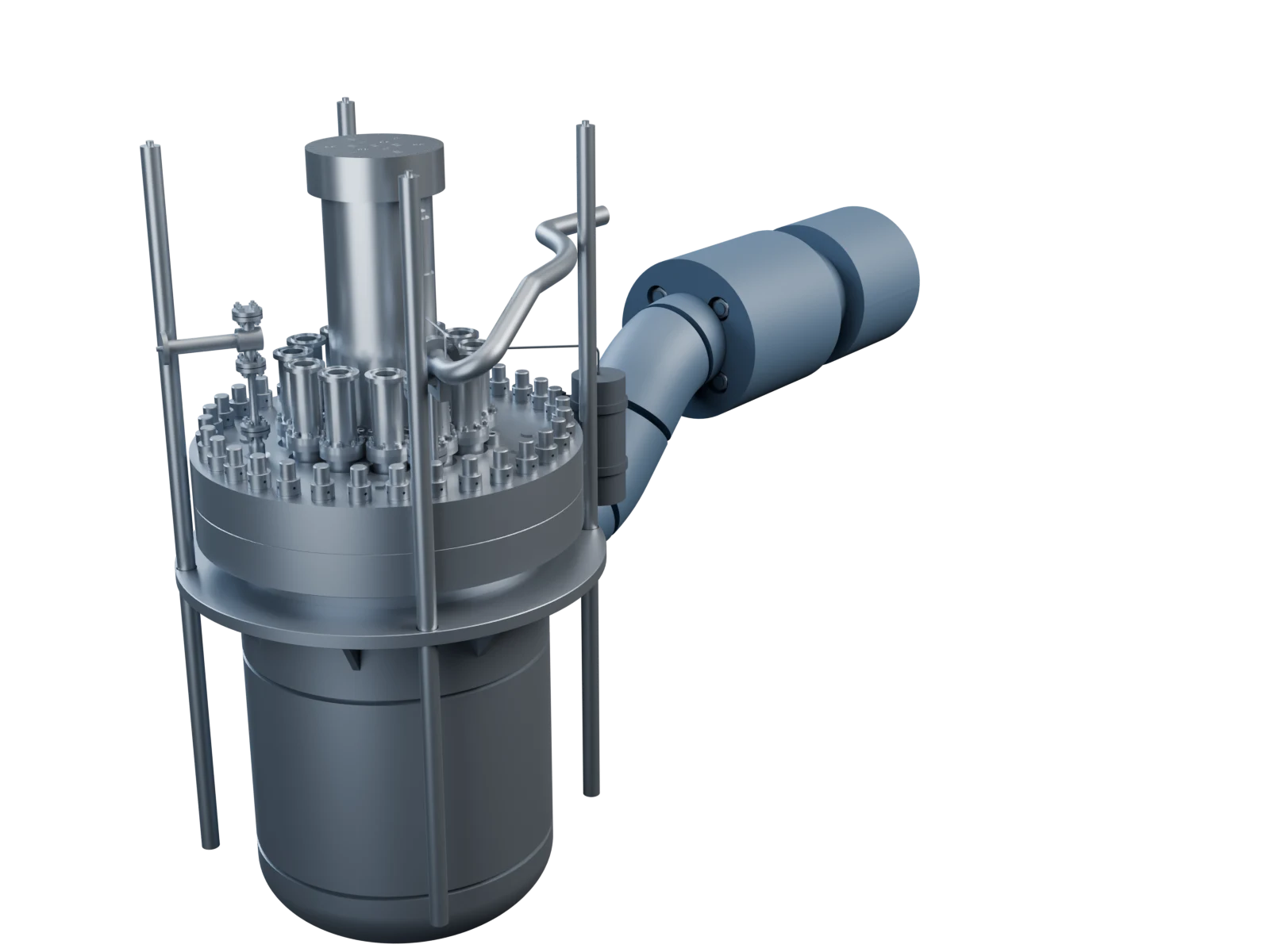 CAD model render3D modelDrag to rotate
Simplified 3D model for illustration: external surfaces only, no dimensions.
Calculation results: the 1 MW microreactor
Numerical verification · November 2026The EMT-NEP-X terrestrial microreactor, rated at 1 MW thermal, has been verified as a complete system with the calculation method that is the international standard of reactor physics: Monte Carlo neutron transport over the full three-dimensional core, isotopic evolution of the fuel, thermal-hydraulics, the power conversion cycle and passive cooling after shutdown. The calculations were run on the EMT Compute platform, on NVIDIA H100 and A100 server nodes. The values shown are the results of these calculations on the reference design.
Method: the international standard of reactor physics
We adopted the same methodology, the same class of calculation codes and the same evaluated nuclear data libraries that form the international reference for reactor design and verification, used by national laboratories, space agencies, nuclear safety authorities and universities. The code is developed and validated by the international scientific community against benchmark criticality experiments. Every result is reproducible: model, data and calculation settings are documented.
Complete three-dimensional model
The core is described element by element in three dimensions: every fuel rod, the moderator, the reflectors, the control drums, the rods and the gas channels, without simplification or homogenisation.
Continuous-energy Monte Carlo transport
Each neutron is followed individually from birth in fission to absorption or leakage, with interaction probabilities in continuous energy: this is the reference method, free of the approximations of deterministic methods.
Reference evaluated nuclear data
Neutron interaction probabilities come from the international evaluated nuclear data library ENDF/B-VIII.0, including temperature effects and the chemical binding of hydrogen in the moderator.
Declared uncertainties
Every value comes with its statistical uncertainty: 12 million neutron histories per state, uncertainty on k below 0.0005; the curves show the 2σ band.
Fuel evolution
Transport is coupled to the isotopic evolution equations, with the ENDF/B-VIII.0 decay and fission chain, to calculate how the core changes over years of operation at 1 MW.
Conservative acceptance criteria
Results are compared against conservative criteria customary for small reactors: cold shutdown with k < 0.95 even with the most effective rod stuck, shutdown with the safety bank and drums alone with k < 0.99, flooding with k < 0.98, end of life at k = 1.005, moderator within its stability limit.
Energy balance in cogeneration
Of the core thermal power, 30 % becomes electricity through the closed Brayton cycle; 37 % is recovered as hot water at 60–90 °C for district heating, industrial processes, desalination or hydrogen production; the remainder is rejected to the environment by dry coolers. The electrical output accounts for the calculated pressure losses of the core, ducts and heat exchangers and for the turbomachinery efficiencies.
Burnup at full power
Multiplication factor k with all control elements withdrawn, at operating temperature, for up to 10 years at 1 MW: Monte Carlo transport coupled to the isotopic evolution equations (ENDF/B-VIII.0 decay and fission chain). The band shows the 2σ statistical uncertainty. With the conservative end-of-life criterion k = 1.005 the core delivers full power for about 8.3 years without refuelling, about 22 GWh of electricity; at reduced load the life increases proportionally. The curve is calculated without the thin inner liner of the fuel element, whose effect (about −0.2 years) is included in the stated value.
Operating and shutdown states
k calculated in six core states, each with 12 million neutron histories. In operation the reactor has a reactivity margin that compensates burnup; when cold, with all rods and drums inserted and the most effective rod stuck out, k = 0.875 (criterion k < 0.95); the safety bank with the drums alone is enough to make it subcritical (k = 0.965); even if flooded with water, a reference accident for transportable reactors, and with the most effective rod stuck out, the core stays below the k < 0.98 criterion.
Passive cooling after shutdown
Shutdown with loss of forced circulation and electrical power: decay heat is removed only by conduction and radiation to the pressure vessel and from there to naturally circulating air. The average core temperature peaks at 561 °C in the first hours and then decreases, 65 °C below the moderator stability limit, with no operator action and no active systems.
Summary of verifications
| Check | Calculated value | Criterion | Outcome |
|---|---|---|---|
| Criticality in hot operation | k = 1.0350 ± 0.0002 | k > 1 with burnup reserve | ✔ verified |
| Fuel temperature coefficient | −0.51 pcm/K | negative | ✔ verified |
| Cold shutdown, safety bank and drums | k = 0.965 | k < 0.99 (single system) | ✔ verified |
| Cold shutdown, most effective rod stuck out | k = 0.875 | k < 0.95 | ✔ verified |
| Hot shutdown with safety bank and drums only | k = 0.964 | k < 0.99 | ✔ verified |
| Flooding, most effective rod stuck out | k = 0.919 | k < 0.98 | ✔ verified |
| Passive cooling without electrical power | 561 °C max | < 627 °C | ✔ verified |
| Full-power life without refuelling | ≈ 8.3 years | k ≥ 1.005 | ✔ verified |
Calculation methods and tools
- Neutronics
- OpenMC 0.15 · continuous-energy Monte Carlo · heterogeneous 3D model of the full core
- Nuclear data
- ENDF/B-VIII.0
- Statistics
- 12 million histories per state · 2.5 million per burnup step
- Fuel depletion
- Transport–depletion coupling · 18 steps up to 10 years · ENDF/B-VIII.0 chain
- Cycle and thermal-fluids
- Closed Brayton cycle, pressure losses and heat transfer with CoolProp fluid properties; turbomachinery and printed-circuit heat exchangers sized
- Passive safety
- Decay-heat transient with conduction and radiation to the environment
- Mechanical design
- Complete 3D CAD model of the plant · pressure vessel to ASME VIII · ISO container modules · automatic interference checking
- Computing
- EMT Compute · NVIDIA H100 and A100 server nodes
Numerical data behind the charts
| years | k | ±2σ |
|---|---|---|
| 0.00 | 1.0350 | 0.0017 |
| 0.00 | 1.0325 | 0.0016 |
| 0.08 | 1.0318 | 0.0012 |
| 1.00 | 1.0255 | 0.0014 |
| 2.00 | 1.0208 | 0.0014 |
| 3.00 | 1.0162 | 0.0016 |
| 4.00 | 1.0165 | 0.0014 |
| 4.50 | 1.0145 | 0.0014 |
| 5.00 | 1.0139 | 0.0017 |
| 5.50 | 1.0124 | 0.0013 |
| 6.00 | 1.0113 | 0.0013 |
| 6.50 | 1.0094 | 0.0016 |
| 7.00 | 1.0095 | 0.0014 |
| 7.50 | 1.0082 | 0.0014 |
| 8.00 | 1.0064 | 0.0016 |
| 8.50 | 1.0060 | 0.0014 |
| 9.00 | 1.0036 | 0.0013 |
| 9.50 | 1.0023 | 0.0015 |
| 10.00 | 1.0009 | 0.0012 |
| core state | k | ±1σ |
|---|---|---|
| Cold start · controls withdrawn | 1.0229 | 0.0003 |
| Hot operation · controls withdrawn | 1.0350 | 0.0002 |
| Hot shutdown · safety bank and drums | 0.9636 | 0.0003 |
| Cold shutdown · safety bank and drums | 0.9646 | 0.0003 |
| Cold shutdown · most effective rod stuck | 0.8749 | 0.0003 |
| Flooding · most effective rod stuck | 0.9193 | 0.0003 |
Read the technical report Live simulator
Dimensions, number and arrangement of elements, fuel enrichment and mass, material compositions, cycle conditions and construction details are not published: they are confidential intellectual property, shared with qualified partners under a non-disclosure agreement.
The test without fissile material
EMT method · patent applicationBefore any nuclear activity, the real core is brought to operating temperature by induction heating, with no uranium or other fissile material. Materials, thermal expansion, heat transfer and gas circuits are thus verified under representative conditions with conventional laboratory equipment. This method is also the subject of an EMT patent application.
Program status
Updates- 2026
- Definition of the core architecture and of its two applications, in space and on the ground.
- 2026
- Monte Carlo neutronic analysis campaign over successive configurations, up to the reference configuration: criticality, negative temperature coefficient and shutdown systems verified by calculation.
- November 2026
- Three invention patent applications filed with the Italian Patent and Trademark Office: the core with its systems, the non-nuclear test method, and the core with a hexagonal-cell moderator region.
- November 2026
- Complete calculation-based verification of the 1 MW microreactor: core, fuel depletion, power conversion, passive cooling and three-dimensional mechanical design of the plant.
- Next steps
- Non-nuclear thermal test of the core by induction; collaborations with research institutions and universities; participation in European small modular reactor programs; licensing pathway for the nuclear phases.
Context: fission in space
- 1965
- SNAP-10A, United States: the first fission reactor in orbit.
- 1970–1988
- Soviet Union: more than thirty satellites powered by BES-5 “Buk” reactors; TOPAZ reactors fly in 1987.
- 2018
- NASA and NNSA: KRUSTY ground test of the Kilopower project, the first US demonstration of a new space reactor in decades.
- Today
- Space agencies are preparing reactors for lunar surface power and nuclear propulsion; the European Union supports small modular reactors through a dedicated industrial alliance.
Safety and non-proliferation
EMT holds no nuclear material. Current activities are design, calculation and non-nuclear testing. Any phase involving fissile material will be carried out only with the authorization of the national nuclear safety authority and in compliance with Euratom and IAEA safeguards, export control law and non-proliferation regimes.
For space use, the program follows the internationally shared principle of launching with the reactor off: the core is started only once a safe orbit has been reached, and before start-up the fresh low-enriched fuel has very low radioactivity.
Intellectual property
- 102026000033457
- Gas-cooled fission reactor core and related space nuclear system for propulsion and power, microreactor and manufacturing method · Italian Patent Office, 10 November 2026
- 102026000033304
- Non-nuclear test of the core at operating temperature by induction · Italian Patent Office, 10 November 2026
- 102026000033811
- Gas-cooled nuclear reactor core with a hexagonal-cell moderator region and associated manufacturing method · Italian Patent Office, 12 November 2026
Invention patent applications. Applicant: EMT Aerospace Technologies S.r.l. · Inventor: Edgar Manzella. Their contents will be published by the Office within the statutory terms.
Nuclear microreactor · questions and answers
EMT-NEP-X: frequently asked questions
What is EMT-NEP-X?
EMT-NEP-X is the nuclear energy program of EMT Aerospace Technologies: a high-temperature gas-cooled nuclear fission microreactor with Generation IV characteristics, designed to supply electricity and heat on Earth and, in the longer term, propulsion and power in space.
How much energy does the EMT-NEP-X microreactor produce?
One 1 MW thermal module produces 303 kW of electricity with a closed Brayton cycle turbine (30.3 % efficiency) and about 373 kW of useful heat, for example for district heating. Overall about 68 % of the fuel energy is used.
How often does it need refuelling?
About every 8 years: calculations give about 8.3 years of full-power operation without refuelling and about 22 GWh of electricity per core.
Is the microreactor safe?
The reactor shuts itself down and cools itself passively, with no pumps and no operators. Passive shutdown and cooling have been verified by calculation to international research standards.
How were the design values calculated?
With the OpenMC Monte Carlo code and ENDF/B-VIII.0 nuclear data, on H100 and A100 compute nodes of the EMT Compute platform. They are design values calculated and verified to international research standards, not yet measured on a prototype.
What does “Generation IV characteristics” mean?
It means the microreactor uses solutions typical of Generation IV nuclear systems: high-temperature gas cooling, passive safety, high efficiency and long fuel cycles. It is not a certification claim: it describes the type of technology chosen.
What fuel does it use?
Low-enriched HALEU uranium, enriched below 20 %. EMT does not hold any nuclear material today: current activities are design, calculation and non-nuclear testing.
Who is a microreactor like EMT-NEP-X for?
Neighborhoods and cities, with electricity and district heating; industrial sites; remote bases and communities that today depend on diesel. Several modules can be combined to increase power.
What is the test without fissile material?
It is EMT’s method for testing the real core before any nuclear activity: the core is brought to operating temperature by induction heating, with no uranium or other fissile material, and materials, thermal expansion, heat transfer and gas circuits are checked with conventional laboratory instruments. The method is the subject of an EMT patent application.
Why test the core without fissile material?
Because it makes it possible to check the thermal and mechanical behavior of the real core under representative conditions, in a conventional laboratory and with no radioactivity, before the nuclear phases, which will only take place with the authorization of the nuclear safety authority.
What is the status of the EMT-NEP-X program?
The construction design and the calculation verification of the 1 MW microreactor are complete, and patent applications have been filed with the Italian Patent and Trademark Office. The next steps are the non-nuclear thermal test of the core and the prototype, with research bodies, universities and international small modular reactor programs.
Can I see how it works?
Yes: the live simulator at emtaerospacetechnologies.com/nuclear-live shows in real time how much electricity and heat the microreactor supplies to a city, an industrial site and a remote base.
Collaborations
EMT welcomes scientific and industrial collaboration with universities, research institutions, space agencies and nuclear supply-chain partners, in particular within European programs on small modular reactors and nuclear power in space. Detailed technical information is shared only under a non-disclosure agreement.
Images are illustrative and do not depict built hardware. Published results are calculations on the reference design. Detailed geometries, materials and design parameters of the EMT-NEP-X program are confidential intellectual property of EMT Aerospace Technologies S.r.l., disclosed only under a non-disclosure agreement (NDA).
Last updated: 12 November 2026 · Program lead: Edgar Manzella, Managing Director