
AI system-on-chip for space
RIGEL
RIGEL brings onboard artificial intelligence to satellites and spacecraft: data is processed where it is collected, with fault tolerance built into every layer of the chip.
Onboard processing
A satellite collects more data than it can send to the ground. With RIGEL, processing happens on board, where the data is collected.
The chip combines a neural accelerator, a RISC-V application processor and a set of fault protections designed together with the architecture, not added afterward.
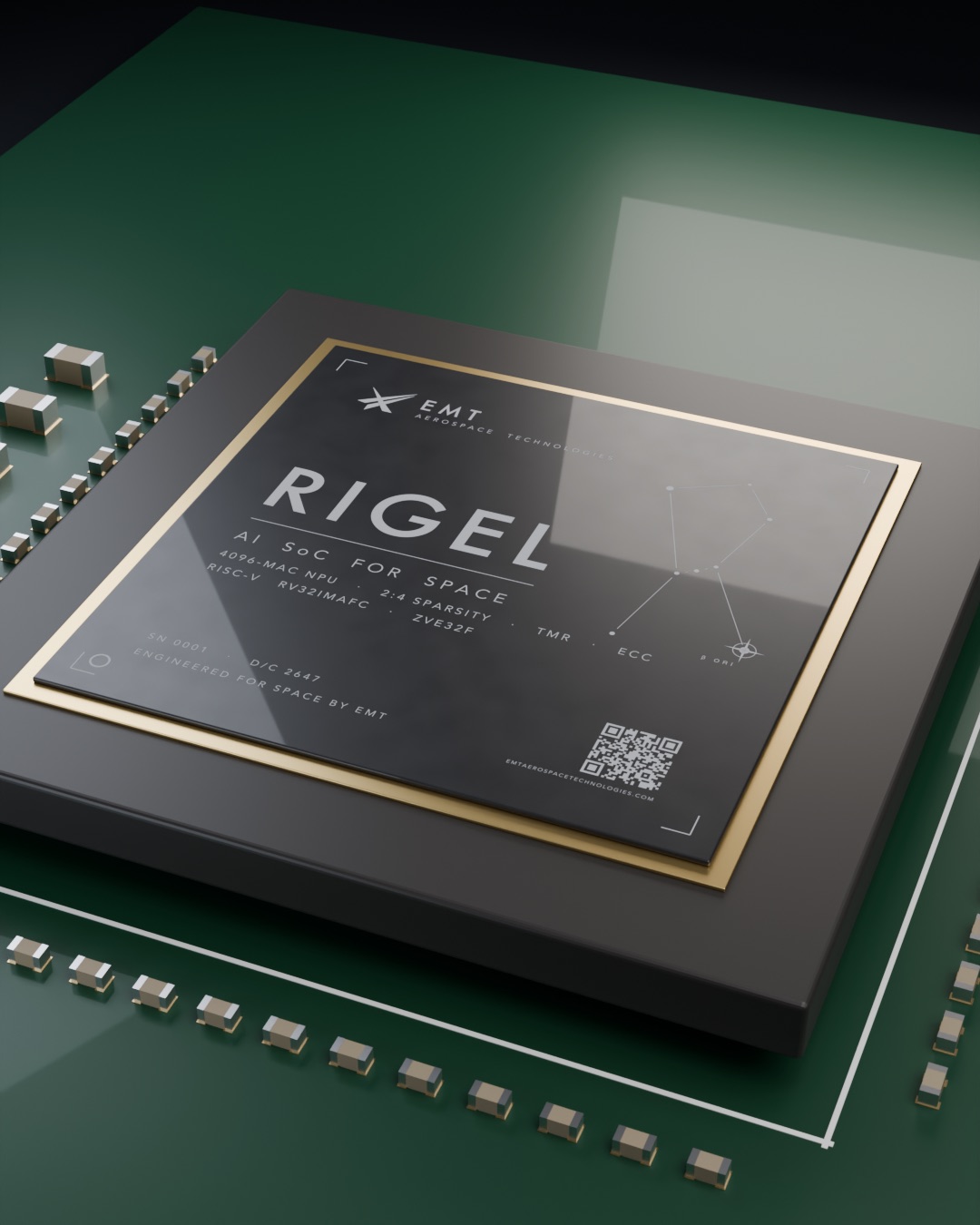 Rendering
Architecture
Neural compute, verified low-precision math and an application processor on the same chip.
4,096 MACs with structured sparsity
A neural processing unit organized as 4×4 tiles of 256 MACs each, with 2:4 structured sparsity.
Low precision, verified results
INT8 math, plus FP8 (E4M3/E5M2) and BF16 low-precision math with exact checksum verification before rounding.
Application core
RISC-V RV32IMAFC processor with the Zve32f vector extension, dual-core lockstep with rollback recovery.
Fault tolerance by design
RIGEL is rad-tolerant by design, built for radiation environments. Its protections work together and are coordinated by the chip itself.
Redundancy and ECC memories
Triple modular redundancy (TMR) and SECDED ECC memories.
ABFT checksums
Checksums computed at buffer write, with diagnosis of where the error is.
Checksums with sparsity
Checksum verification also works with structured sparsity.
Lockstep cores
Lockstep cores with deferred-verification checkpoints and rollback.
Undo log
A memory-side undo log enables recovery without a reset.
Radiation-level estimator
An on-chip estimator assesses the radiation level and coordinates the protections.
Interfaces
- Links
- SpaceWire (ECSS) · MIL-STD-1553B · Ethernet with 802.1AS time sync · CAN FD · I²C · SPI · UART
- External memory
- DDR3/DDR3L controller
- Platforms
- Adapters for SpaceVPX and CubeSat platforms
Status and intellectual property
- Status
- In physical implementation
- Intellectual property
- Six patent applications filed on November 26, 2026 · patent pending
Patent applications filed
| Application no. | Technology | Summary |
|---|---|---|
| 102026000035260 | Radiation-level estimator | The chip estimates the radiation level on its own from the activity of its logic and compute circuits, and adjusts all the protections accordingly, in a coordinated way. |
| 102026000035263 | Neural accelerator result checking | Checksums are computed as data enters the systolic array’s buffers: an error is detected and its location is identified. |
| 102026000035272 | Lockstep with verified recovery | Two processor cores run in parallel; recovery points are confirmed after a delay, and rollback takes into account writes that cannot be undone. |
| 102026000035275 | Recovery without reset | A memory-side undo log keeps the previous values and classifies the writes, so the system returns to the correct state without restarting. |
| 102026000035278 | Checking with structured sparsity | Even when the neural network’s weights are compressed with structured sparsity, the full checksums are reconstructed and every row and column is checked exactly. |
| 102026000035284 | Exact checking in low precision | In low-precision floating-point math such as FP8, checksums are kept in fixed point and the result is verified exactly before rounding. |
Invention patent applications filed on November 26, 2026 in the name of EMT Aerospace Technologies. Patent pending.
The name
RIGEL is named after Rigel (β Orionis), the brightest star in Orion. The constellation’s stars are engraved on every lid.